Guide: wind, tide, and waves for Kite and Wingfoil
Wind, tide, and sea conditions dictate your session before you even hit the parking lot. Learning to read them correctly means picking the perfect window, the right kite size, and the ideal spot. It also means knowing when to call it a day if the conditions are beyond your skill level. This guide shares the benchmarks we use daily on the coast, right here in Pornichet and La Baule, for both kitesurf and wingfoil. Kite and wing equipment is in our Kitesurf and Wing Foil worlds.
A great session hinges on three factors: consistent wind within your kite's range, enough water and beach at the right tide, and a sea state that matches your skill level.
For learning, the sweet spot is between 12 and 20 knots, with side-shore or side-on shore wind, ideally on a rising tide. Above 20 knots, the power gets tough to handle, and your margin for error shrinks fast.
In summary
- 12 to 20 knots: the range for learning without fear.
- Side-shore and side-on shore: the two best wind directions.
- Off-shore: never ride without a safety boat.
- Rising tide: the current brings you back to the beach.
- Strong coefficient: more current, less beach, less margin for error.
- Long, spaced-out swell: much more comfortable than big, close-together waves.
Wind: The Engine of Your Session
No wind, no riding. But it's not just about the wind blowing; four characteristics are just as important as the speed shown on your app.
Wind Strength
Every kite has an optimal wind range set by its manufacturer. Below this range, you'll lack power and struggle. Above it, control becomes difficult, and your gear takes a beating. The stronger the wind, the smaller the kite should be, and vice versa. This is why an advanced rider often has two or three kite sizes.
To start, you can ride from 12 knots with a kite suited to your body size. It's best to stay under the bar of 20 knots while you're learning the basics.
Wind Direction
| Orientation | What it means on the water | Verdict |
|---|---|---|
| Side-shore, parallel to the coast | You ride along the beach and easily return to your starting point. | The best compromise. |
| Side-on shore, angled towards the beach | The wind pushes you towards the shore. This makes it easy to return to the edge. | Ideal for learning. |
| On-shore, facing the beach | Waves come from the front. This makes launching and landing technical. | Rideable, but more demanding. |
| Off-shore, out to sea | The wind pushes you away from the coast and becomes irregular near the shore. | Avoid without a safety boat. |
Consistency
Consistent wind makes for an enjoyable session. Gusty wind, however, is tiring, makes your kite unpredictable, and leads to more unpleasant surprises. If you're choosing between a steady 15 knots and a choppy 20 knots, always go for the 15.
Local Effects
Remember, the forecast describes a general area, not your specific spot. Summer thermals can add several knots in the early afternoon. Cliffs, dunes, or built-up areas create windless zones and gusts directly downwind. If you're at an unfamiliar spot, take about ten minutes to observe the water before you rig up.
The Beaufort scale: how to translate forecasts
Marine bulletins use Beaufort, while most forecast apps show knots or km/h. Here's how they correspond.
| Beaufort Number | Descriptive Term | Speed (knots) | Speed (km/h) |
|---|---|---|---|
| 0 | Calm | < 1 | < 1 |
| 1 | Very Light Breeze | 1-3 | 1-5 |
| 2 | Light Breeze | 4-6 | 6-11 |
| 3 | Gentle Breeze | 7-10 | 12-19 |
| 4 | Moderate breeze | 11-16 | 20-28 |
| 5 | Fresh breeze | 17-21 | 29-38 |
| 6 | Strong breeze | 22-27 | 39-49 |
| 7 | Near gale | 28-33 | 50-61 |
| 8 | Gale | 34-40 | 62-74 |
| 9 | Strong Gale | 41-47 | 75-88 |
| 10 | Storm | 48-55 | 89-102 |
| 11 | Violent Storm | 56-63 | 103-117 |
| 12 | Hurricane | ≥ 64 | ≥ 118 |
One knot equals 1.852 km/h. These values represent the average wind speed, not gusts. Gusts commonly exceed the average wind by 20 to 30 percent.
Tide: the parameter riders often forget
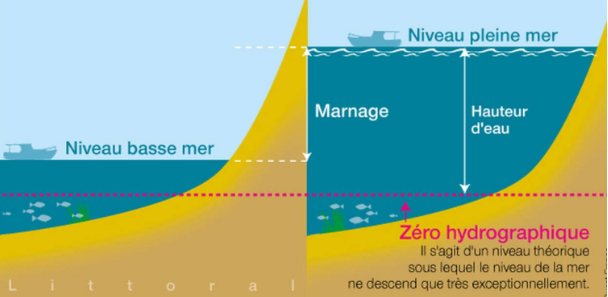
On the Atlantic coast, the tide influences your session as much as the wind. In just a few hours, it can change the water depth, beach width, current strength, and even wave shape.
High Tide or Low Tide
At low tide, keep an eye out for sandbanks, rocks, and overly shallow areas. If you're foiling, there's a real risk of hitting the bottom, and some spots simply become unrideable. At high tide, you'll be riding closer to shore. The space to launch and land your kite or wing shrinks. Sometimes it disappears entirely on days with high coefficients.
The Coefficient
A high coefficient means a large tidal range: narrow beaches at high tide, strong currents, and rapidly changing water conditions. Small coefficients result in gentler tides, which are more comfortable for learning wingfoil or consolidating your kitesurf skills.
Rising or Falling
| Situation | What the current does | What we recommend |
|---|---|---|
| Rising tide | It pushes you towards the beach | The safest setup for beginners |
| Falling tide | It pulls you out to sea | Be careful, especially with offshore or side-shore winds |
| Slack tide | Weak current, calmer water | A good window for your first session at an unknown spot |
Always check the tide times for your spot before you head out. Some spots are only rideable at mid-tide, while others become completely unrideable at low tide.
Waves and sea conditions
Flat water makes learning and freestyle easier. Choppy water or disorganized swell complicates everything, even just holding your course. A long, regular swell, on the other hand, is exactly what you're looking for in both surfkite and wingfoil.
Height isn't the only factor: the period, which is the time between two waves, matters just as much. A small swell with 10 to 12 seconds between waves offers more push and comfort than a higher wave with only 5 seconds between them.
Combine the three parameters
It's the combination of wind, tide, and sea state that makes a session, not just one parameter on its own.
| Wetsuit | What it means | Who is it for? |
|---|---|---|
| Consistent side-on 15 knots, rising tide, clean swell | Reference conditions | All levels |
| Side-shore 20 knots, mid-tide, flat water | Freestyle playground | Intermediate and advanced riders |
| Off-shore, falling tide, short chop | Tricky situation, drifting offshore | No one without assistance |
Where to check before you go
| Need | Tool |
|---|---|
| Detailed wind forecast | Windguru, La Baule and Pornichet spot |
| Real-time observed wind | Winds-Up |
| Tide times and coefficients | Maree.info and SHOM |
| Sky conditions and squall arrival | Satellite images and precipitation radar |
| See the body of water before coming | La Baule Webcam |
Reflexes to avoid bad sessions
- Observe the body of water for at least ten minutes before rigging.
- Never ride alone, even on a busy spot.
- Adapt kite size to the actual wind, not the wind announced the day before.
- Give up if the conditions on site do not match the forecast.
- Vary your spots to learn how to read different configurations.
Sources and limits of forecasts
Tide heights and times are certified by the SHOM. For wind, sea state, and warnings, Météo-France Marine bulletins remain the reference. Consult them in addition to the models cited here. A forecast describes an area and a trend, never the exact conditions on your spot. Topography, thermal effects, squalls, currents, and sea state can create a difference in minutes.
FAQ: wind, tide, and waves
How much wind do you need to kite or wing?
With the right Kite size for your body size, you can start riding in as little as 12 knots. When you're learning, it's best to stay between 12 and 20 knots. Above that, the power becomes much harder to manage.
Which wind direction is safest?
Side-shore wind runs parallel to the coast. Side-on shore wind blows diagonally towards the beach. Side-on shore is the most reassuring for learning, as the wind pushes you back to shore.
Can you ride in off-shore wind?
No, not without a safety boat. An off-shore wind carries you away from the coast. It also often becomes irregular near the shore due to terrain and buildings.
Should you ride on a rising or falling tide?
A rising tide is safest for beginners. The current pushes you towards the beach. On a falling tide, the current pulls you offshore, so you need to be more vigilant.
What changes with a high tidal coefficient?
A high tidal coefficient means a greater amplitude. This results in stronger currents, smaller beaches at high tide, and a rapidly changing body of water. Smaller coefficients are more comfortable for learning.
How to read the swell before a session?
Look at the height, but more importantly, the period. A low swell with 10 to 12 seconds between waves is cleaner and more comfortable than a higher wave with only 5 seconds between them.
Questions about your conditions or gear?
You don't need to live in the region. Call us or book an appointment with a team rider, by phone or video call. We'll help you determine the right Kite size for your body size and your spot's conditions.
Book an appointment Call us Email usThis GlissEvolution editorial guide is based on our daily practice on the Loire-Atlantique coast. The figures are indicative. They do not replace official bulletins or direct observation of the spot.