Duotone Crest D/LAB 2026: Hydro Gav's test and review
Hydro Gav had never really clicked with Duotone foils. He found them decent, nothing more. In such a competitive market, "decent" isn't enough to make a rider switch systems. But with the Crest D/LAB, he changed his mind in minutes. It's now the foil he grabs when he's not filming videos.
Huge thanks to Hydro Gav for his review of the Duotone Crest D/LAB, published on his YouTube channel on April 3, 2026.
The Duotone Crest D/LAB 2026 is a carbon foil Front Wing from the D/LAB range. It's available in six sizes, from 550 to 1200 cm², with prices ranging from €789 to €1.039 including VAT for the Front Wing alone.
Duotone positions the Crest D/LAB between the more lively Carve 3.0 and the glide-focused Glide 2.0. It's designed for prone, wave, and freefly riding. This Front Wing mounts on all D/LAB tails, S and PX stabilizers, and the new Monobloc tails. Prices were current in our catalog on October 2, 2026.
The tester's takeaways
- A balanced Front Wing: it's not the absolute best for pumping, nor the best for glide, but very few Front Wings perform both so well while still turning correctly.
- Predictable lift, free from sudden jerks or stalls, and a high tolerance for rider error.
- The D/LAB system, with finishes he considers among the best.
- Some minor assembly annoyances and a bag that tends to collect sand.

Who tested it, and under what conditions
Hydro Gav is an English-speaking tester who reviews a lot of foil gear and constantly changes his setup. He rode the Crest D/LAB for parawing, winging, and prone on waves, with some downwind sessions. His review does not specify the size used.
We do not have a Crest D/LAB in our test fleet. Everything that follows regarding the Front Wing's behavior comes from his review. Sizes and compatibility come from Duotone, and prices from our catalog.
Review by Hydro Gav, in English, published on April 3, 2026, duration 8 min 33.
The D/LAB system: the first pleasant surprise
Even before riding the Front Wing, the platform itself won him over. Tight adjustments, clean carbon, and nothing wiggles. With lightweight gear, he often worries about a lack of stiffness. Not here: he describes a firm and direct setup when loaded.
On the water, the ride feel was immediately familiar. He's been riding Armstrong a lot lately and places the Crest in the same family. He considers this a compliment. No strange behavior, no adaptation time needed. He calls it accessible performance. This is exactly what he looks for when he changes gear so often.
Monobloc tails and rail sliders
He's a big fan of Monobloc tails. The stabilizer comes pre-set by experts. This saves you hours of searching for the perfect fuselage and stabilizer combination. Fine adjustments are still possible for those who want them, but he prefers a ready-to-ride setup.
Another appreciated detail: the sliding nuts for the board's rail are included with the kit. Just slide the mast in, tighten, and go. No more fumbling to align nuts in the rail.
The Crest on the water: the happy medium

His assessment is honest: some Front Wings pump better, others glide longer, and some turn harder. Very few do all three as well as the Crest. It's fast, re-accelerates with pumping to link waves. Then it turns cleanly once on the bump.
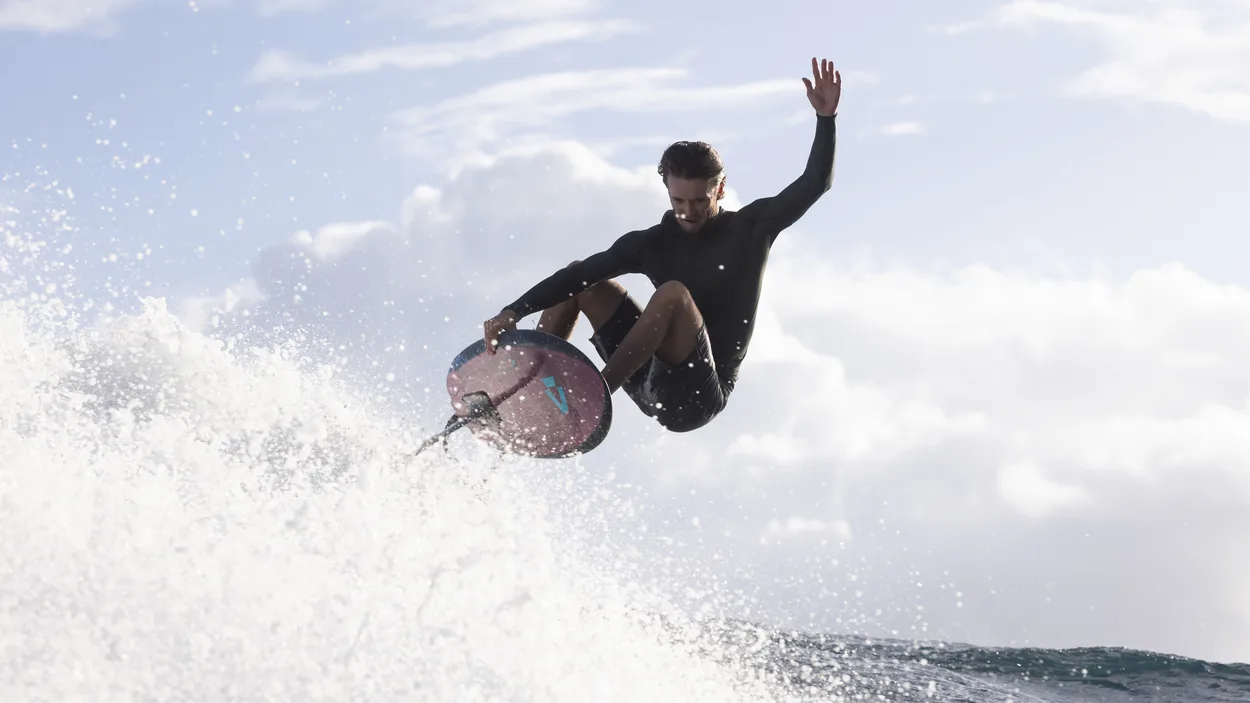
What keeps him coming back to it is its tolerance. You can push it, even overdo it a bit, and the Front Wing recovers underfoot instead of punishing you. He uses it for parawing, wing, prone, and even downwind.
Lift that warns
The lift builds progressively, without sudden peaks or stalls. This gives you time to react. For parawing, where power comes in bursts, he finds it's where it performs best. It's also stable in pitch: your front foot doesn't have to constantly correct. The Front Wing settles at the expected height. This allows you to focus on turns or connecting bumps.
Turns and water exits
At the bottom of a wave, during a transfer, or a jibe, the turn remains controlled and smooth. You engage, the Front Wing holds. It doesn't catch mid-turn, and it doesn't stall. Ventilations and wingtip exits are very recoverable. This builds confidence to push harder and progress.
What annoys him
Nothing is insurmountable, but some details only emerge after several sessions.
- The bag. It's well-finished and protective, but the exterior is covered in velcro for attaching pouches. If you don't use them, this velcro snags on carpet, other bags, and especially sand.
- D/LAB assembly. This requires two hands. If you place the wing on the fuselage while reaching for a screw, it tends to tip forward. He notes that this is mainly a matter of getting used to, especially if you're coming from other systems.
- The screws. You'll find both M6 and M8 screws in the same system. He understands the reasoning but would have preferred identical heads. The included tool is excellent and fits well around the mast, but losing it makes assembly a pain.
- The plate. It's solid for durability. He prefers slotted plates where screws slide in, even with the provided sliding nuts.
Crest, Carve, or Glide: Where Does It Fit?

Duotone positions the Carve 3.0 for performance wave, freestyle, and kite, while the Glide 2.0 excels in performance freeride and downwind. The Crest sits in the middle, perfect for prone, wave, and freefly. Hydro Gav's review confirms this: it's a Front Wing that doesn't chase extremes.
If you primarily do long downwind runs, the Glide remains the more logical choice. For a very lively Front Wing for freestyle, check out the Carve. For riders who do a bit of everything, the Crest is the simplest choice.
Who's it for?
This is for the advanced rider who wants a single Front Wing for wing, parawing, and wave, and who prefers a foil that's easy to ride well over a specialized foil in just one area. Duotone's range chart places it at the advanced level. This is not a Front Wing for your first flights.
For a tighter budget, the Crest SLS 2027 carries over the name with an SLS carbon construction, in sizes from 800 to 1200 cm². This review does not cover it.
Sizes and prices
| Surface | Price including tax (Front Wing only) | Availability as of October 2, 2026 |
|---|---|---|
| 550 cm² | €789 | On order |
| 675 cm² | €839 | In stock |
| 800 cm² | €889 | In stock |
| 925 cm² | €939 | On order |
| 1050 cm² | €989 | In stock |
| 1200 cm² | €1,039 | On order |
Prices and stock recorded in our catalog on October 2, 2026. The Front Wing is sold separately; you'll need to purchase the mast, fuselage, and tail separately if you're not already equipped with D/LAB.
Specifications
| Feature | Duotone Crest D/LAB 2026 |
|---|---|
| Type | Foil Front Wing |
| Construction | D/LAB Carbon |
| Surfaces | 550, 675, 800, 925, 1050 and 1200 cm² |
| Intended Program | Prone, wave, freefly |
| Design | Moustache shape, upturned wingtips |
| Compatibility | D/LAB tails, S and PX stabilizers, Monobloc tails |
Things to consider before buying.
If you already have a system from another brand, you can't just swap out the Crest; the entire D/LAB system follows, and the bill quickly adds up. If you primarily do downwind, the Glide will serve you better. And if your budget is under €700, check out the Crest SLS 2027, keeping in mind that it is not the one tested here.

Frequently asked questions about the Duotone Crest D/LAB 2026
What is the Duotone Crest D/LAB used for?
It's a versatile Front Wing, positioned by Duotone between the Carve 3.0 and the Glide 2.0, for prone, wave, and freefly. Hydro Gav also used it for wing, parawing, and downwind.
Is the Crest D/LAB easy to ride?
Yes, it's perfect for an advanced rider. Hydro Gav reports that the lift comes on smoothly, the wing maintains excellent pitch stability, and it's forgiving of errors. Duotone positions this as an advanced-level Front Wing, not for your first flights.
What sizes are available for the Crest D/LAB 2026?
You can choose from six surfaces: 550, 675, 800, 925, 1050, and 1200 cm². As of October 2, 2026, the Front Wing alone ranges from 789 to €1,039 including tax in our catalog.
What is the Crest D/LAB compatible with?
Duotone states that it's compatible with all D/LAB tails, S and PX stabilizers, and Monobloc tails. You can mount it on any fuselage and mast from the D/LAB range.
Crest D/LAB or Crest SLS 2027?
The D/LAB is the version Hydro Gav tested, featuring D/LAB carbon and available from 550 to 1200 cm². The SLS 2027 is a more budget-friendly option, ranging from 559 to €709 including tax, in sizes from 800 to 1200 cm². We haven't tested the SLS yet, so give us a call to compare based on your riding style.
What are the drawbacks of the Crest D/LAB?
Hydro Gav noted a few things: the bag's velcro tends to pick up sand, assembling the D/LAB requires two hands, it uses both M6 and M8 screws in the same system, and it has a solid top plate instead of notched ones.
Unsure about the size or the right Front Wing?
Choosing between the Crest, Carve, and Glide depends on your weight, your board, and your primary riding style. Often, a quick call is all it takes to find your perfect match.
Book an appointment09 62 64 74 77Email us
Test source: Hydro Gav video review, published April 3, 2026. Stated features and positioning: Duotone Front Wing Crest D/LAB product page and Boards & More catalog (reference 42260-3848), consulted October 2, 2026. Photos and diagram: Duotone. Prices, sizes, and stock noted in our catalog on October 2, 2026.

 Duotone