How to Choose Your Wingfoil Foil: The 2026 Guide
When you're wingfoiling, your foil pretty much calls all the shots: how easy your take-off is, your stability in flight, your speed, and your handling. It's even more critical than your board. Foils, boards and wings from the Wing Foil department are in stock in Pornichet. This guide breaks down the five key components of a foil, explaining how each one impacts your ride on the water, and then gives you the essential benchmarks for making your choice. Your skill level and weight will determine the size you need, while your preferred riding style will dictate the shape.
A wingfoil foil consists of a mast with its top plate, a fuselage, a Front Wing, and a stabilizer.
The Front Wing dictates lift, the mast controls your flight height, and the fuselage and stabilizer manage balance and turning. For progression, the safest bet is an 85 cm carbon mast paired with a Front Wing around 1,500 cm².
Quick Benchmarks
- Mast: Start with aluminum, then move to carbon once you're intermediate.
- Mast length: 70 to 80 cm for learning, 85 cm is the standard, and 90 cm and up for surf and downwind.
- Front Wing: 1,700 cm² and up for beginners or light wind, 1,100 to 1,700 cm² for progression, and less than 1,100 cm² for advanced riders.
- Fuselage: A longer fuselage provides stability, while a shorter one offers more handling.
- Stabilizer: A large stabilizer is more forgiving. A smaller one makes the foil more responsive.
- Your body size will shift your ideal choice up or down one notch within each range.
The Five Parts of a Foil
Before you compare models, it helps to understand what each part does. A foil disassembles, and most parts are interchangeable. This lets you upgrade your gear without buying an entirely new setup. F-One's Front Wings and Monobloc stabilizers are molded with their section of the fuselage.
| Part | Its role | What it changes on the water |
|---|---|---|
| The top plate | This component secures the mast to your board, typically using two US rails, or sometimes a Deep Tuttle box. | It determines the compatibility between your board and your foil, so always check this before you buy. |
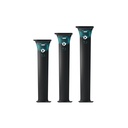
| The mast | The mast sets your flight height above the water. | Its material and length impact stiffness, weight, and how much margin you have for error. |
| The fuselage | The central component that connects the mast to both wings. | Its length balances stability and responsiveness. |
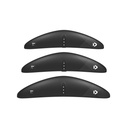
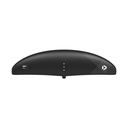
| The Front Wing | This is the most crucial part: it's what generates lift. | Surface area, profile, and aspect ratio determine lift, take-off speed, and handling. |
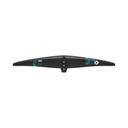
| The Stabilizer | This is the smaller Rear Wing. | It stabilizes pitch. It can either calm or free up the foil. |
Aluminum or Carbon Mast?
This is the first question most riders ask. The answer mainly depends on where you are in your progression.
| Material | Who is it for? | What You Gain, What You Lose |
|---|---|---|
| Aluminum | Beginners, tight budget, recreational use | Aluminum offers an affordable price and good impact resistance. It is heavier, less stiff, and creates more drag in the water. |
| Carbon | Intermediate and advanced riders | Carbon is lighter and stiffer. Its thin profile means less drag. Pumping is significantly more efficient. This comes at a higher investment. |
If your budget allows from the start, a carbon mast is an investment you rarely regret. If you're unsure, start with aluminum. Keep carbon in mind as your first upgrade. It's the component change that makes the biggest difference in ride feel.
What Mast Length?
Mast height is often underestimated. It determines your flight height. This means it sets the margin you have before touching the water or the bottom.
| Length | Who is it for? | What it means |
|---|---|---|
| 70 to 80 cm | Beginners, shallow water, and areas with obstacles. | You'll fly lower, falls are less intense, and it's more forgiving of foot pressure errors. |
| 80 to 90 cm | For intermediate riders, 85 cm is the most common standard. | This offers the best balance of stability and responsiveness. It allows for tighter turns. |
| 90 cm and up. | Advanced riders, swell, downwind | Glides over chop and troughs without touching the water. It offers more amplitude for pumping, but requires skill. |
The proven approach is to start with a shorter mast, then move to a longer one as you progress. Doing the opposite often discourages many beginners.
What Front Wing surface area should you choose?
This is your most critical choice. The Front Wing's surface area directly impacts how quickly you take-off, your low-speed stability, top speed, and how easily you can link turns.
| Surface | Who is it for? | What it means |
|---|---|---|
| 1,700 cm² and up. | Beginners, heavier riders, and light wind conditions. | Expect early take-off and excellent low-speed stability, though you'll sacrifice some top speed and handling. |
| 1,100 to 1,700 cm². | For intermediate riders, around 1,500 cm² offers the best compromise. | This range provides a great balance between lift, handling, and speed. It is the most all-round choice. |
| Less than 1,100 cm². | Advanced riders and strong wind conditions. | You'll get a faster, more reactive ride for committed maneuvers, but be prepared for a more demanding take-off. |
Your body size/build shifts these benchmarks. If you're under 70 kg, aim for the lower end of the range for your level. If you're over 85 kg, go for the upper end, or even the next size up if you often ride in light wind. High aspect wings, with their elongated shape and short chord, are the current performance trend. They glide and pump remarkably well. They are less forgiving and not ideal for your first Front Wing.
Fuselage and stabilizer: your fine-tuning components.
These two parts are often overlooked, yet they define the foil's character.
| Part | Benchmark | Behavior |
|---|---|---|
| Long fuselage. | The manufacturer's longest. | This setup is stable and forgiving. It is ideal for freeride and learning as it tolerates placement errors. |
| Short fuselage. | The manufacturer's shortest. | Maneuverable and reactive, this is preferred for surf and tight turns, but it demands precision. |
| Large stabilizer. | 250 cm² and more. | This calms the foil, reduces oscillations, and is forgiving for learning. |
| Small stabilizer | Less than 200 cm². | More responsive, it frees up your glide and lets you make more radical turns. |
Fuselage lengths are tough to compare across brands because mounting systems vary. Stick to comparing within a single manufacturer's range. Many brands offer interchangeable stabilizers for the same foil; this is the most cost-effective way to evolve your setup as you progress.
Which foil for your riding style?
| Use | Mast | Front Wing | Fuselage and stabilizer |
|---|---|---|---|
| Learning | Aluminum, 70 to 80 cm. | 1,700 cm² and up. | Long fuselage, large stabilizer |
| Freeride and progression | Carbon, 85 cm. | Around 1,500 cm². | Medium fuselage, allround stabilizer |
| Waves and carving | Carbon, 85 cm. | Less than 1,200 cm². | Short fuselage, small stabilizer |
| Downwind and pumping | Carbon, 90 cm and up. | High aspect | Long fuselage, thin stabilizer |
Downwind riding has its own rules, which we detail in How to choose your foil for downwind?
Which Models Should You Consider for 2026 and 2027?
We've selected one model per riding discipline, all new references available on our site. Prices were recorded on September 25, 2026, excluding size options. Sizes and aspect ratios are based on Duotone and F-One data.
| Use | Model | Why This One? | Price |
|---|---|---|---|
| Learning, light wind. | Duotone Lift 2400 2026 | Fiberglass, 2,400 cm². Duotone states take-off under 10 knots. | from €559 |
| Accessible freeride. | Duotone Free 2025 | Fiberglass, in 1,500, 1,750, and 2,000 cm², for beginner to advanced riders. | from €321 (-30%). |
| Freeride and progression | F-One Seven Seas V3 2026 | Aspect ratio 8, from 1,100 to 1,600 cm², with progressive take-off and a wide speed range. | from €879 |
| Waves and carving | F-One SK8 V3 2026 + Tail Carving 2026 | Aspect ratio 8, from 550 to 1,150 cm², with a Monobloc stabilizer designed for carving. | from €799 + €340. |
| Downwind and pumping | Duotone Glide 3.0 SLS 2027 | Carbon SLS, aspect ratio 11 to 12, from 825 to 1,400 cm². | from €569 |
| Ideal for downwind riding and advanced riders. | F-One Eagle X V2 2026 | UHM Carbon, aspect ratio 12, from 500 to 1,000 cm². This is not a Front Wing for beginners. | from €999 |
| Duotone carbon mast | Duotone Mast SLS 2.0 2027 | 76, 84 or 92 cm, integrated plate, 3BS+ insert | from €1,049 |
| F-One carbon mast | F-One Carbon Mast 16 T2 | 80 or 85 cm, Titan 2 connection | from €999 |
Duotone and F-One parts are not interchangeable. For F-One, the 2026 Titan 2 wings do not fit first-generation Titan carbon masts. The brand does not plan to offer an adapter. Always check compatibility before assembly. For the SK8 V3, you can find detailed information on its behavior in F-One SK8 V3 2026: full test and review. See all wing foils.
What Budget Should You Plan For?
This is the base price for new items online as of September 25, 2026, excluding second-hand and sale items. Some sizes are priced higher. Several 2025 or Titan 1 models are currently discounted; this is often where you'll find the best deals.
| Component | Observed range |
|---|---|
| Stabilizer only | 65 to €459 |
| Fuselage only | 199 to €549 |
| Front Wing only | 289 to €1,499 |
| Plane or wingset (Front Wing and stabilizer) | 609 to €1,399 |
| Aluminum mast | 279 to €429 |
| Carbon mast | 859 to €2,399 |
| Complete foil kit | €1,339 to €2,279 |
| Wingfoil pack (foil with board, wing, or both) | €1,929 to €2,498 |
If you're starting from scratch, begin by checking out wingfoil packs. The components are pre-matched, so you won't have to worry about checking connections.
Common Mistakes to Avoid
- Choosing a wing that's too small to start makes take-off a nightmare and stops your progression dead.
- Forgetting to check the attachment: a mast with a Deep Tuttle head won't mount on a board equipped with US rails.
- Mixing generations: with F-One, a Titan 2 Front Wing won't mount on a first-generation Titan carbon mast.
- Neglecting the stabilizer: it's the cheapest part, yet it significantly changes the foil's behavior.
- Taking a long mast too early means more height and harder falls.
- Buying without trying is risky. Two wings with the same surface area won't behave the same way depending on their profile.
Sources and limitations of these guidelines
This guide draws on our extensive field experience and data published by Duotone and F-One for their 2026 and 2027 models. Keep in mind that surfaces, lengths, and price ranges are indicative. The Front Wing's profile, rider's weight, spot conditions, and model year can all shift these benchmarks. Prices were noted on our website on September 25, 2026, and are subject to change.
FAQ: choosing your wingfoil foil
Which foil to choose for starting wingfoiling?
For beginners, an aluminum mast between 70 and 80 cm offers a forgiving and affordable ride. Pair it with a Front Wing of 1,700 cm² or more for early take-off and enhanced stability. A longer fuselage further boosts stability. Opting for a complete set eliminates compatibility concerns, and you can easily upgrade to carbon as your skills advance.
Wingfoil Mast: Aluminum or Carbon?
Aluminum is perfect for beginners. It's more affordable and handles impacts well. Carbon becomes essential at the intermediate level. It offers a lighter, stiffer feel and much more efficient pumping. If your budget allows, starting with carbon is rarely regretted.
What's the Right Mast Length for Wingfoiling?
Start with a 70 to 80 cm mast if you're a beginner, especially in shallow water or crowded spots. As you progress, move to 80 to 90 cm, with 85 cm being the most popular standard. For Surf, pumping, and downwind, go for 90 cm and above. Begin with a shorter mast, then extend it as you improve.
What Front Wing surface area should you choose?
For beginners or light wind sessions, choose a Front Wing of 1,700 cm² or larger. For progression, a Front Wing between 1,100 and 1,700 cm² is ideal. Advanced riders seeking speed and responsiveness should look for Front Wings under 1,100 cm².
Does my weight change the foil choice?
Yes. If you're under 70 kg, target the lower end of the recommended range for your skill level. A smaller wing will still provide lift and offer better control. If you're over 85 kg, choose the upper end of the range, or even the next size up if you frequently ride in light wind conditions.
Can you upgrade a foil without buying everything new?
Yes, as long as you stick to the same mounting system. Upgrading your stabilizer is the most budget-friendly option. Switching from an aluminum mast to a carbon mast delivers the most noticeable improvement in ride feel. You'll want to change your Front Wing as your skill level or riding style evolves.
We'll help you choose your foil
You don't need to live nearby. Just call us or book an online slot, and one of our team riders will call you back. We'll help you dial in the right wing surface, mast length, and fuselage for your body size and local spot.
Make an appointment Call us See wing foilsThis is the GlissEvolution editorial guide. We sell these foils and ride them year-round from Pornichet. Prices and availability are indicative and subject to change.