The COLREGs, International Regulations for Preventing Collisions at Sea, is the 34-page document that determines who maneuvers and who maintains their course on the water.
In summary
- Kitesurf and wing foil are considered recreational craft. Windsurf and paddle boards are also in this category. These common-sense rules apply to them just as they do to larger vessels.
- On the water, there are no priorities, only privileges. Everyone must maneuver to avoid a collision.
- The core principle is simple: the more maneuverable craft must always yield to the less maneuverable. This is based on its current condition, not its type.
- Nine simple rules and two golden rules govern navigation for kite and wing riders, as well as those who windsurf.
The COLREGs, International Regulations for Preventing Collisions at Sea, is the 34-page document that determines who maneuvers and who maintains their course on the water.Kitesurf and wing foil are considered recreational craft. Windsurf and paddle boards are also subject to these common-sense rules, just as vessels are.
In summary
On the water, there are no priorities, only privileges. Everyone must maneuver to avoid a collision.
- The core principle is simple: the more maneuverable craft must always yield to the less maneuverable. This is based on its current condition, not its type.
- Nine simple rules and two golden rulesgovern navigation for kite and wing riders, as well as those who windsurf.
- When jumping, ensure you have 50 m clear downwind and 30 m upwind.
- Golden rule: upwind, keep your kite HIGH; downwind, keep it LOW.
- If you lose equipment at sea, call CROSS at 196. Your name and phone number must be on your kite and board; this is mandatory.
► Sun, sex & priorities:
The sun and wind are back on the coast! But with sunshine comes holidays, and sometimes crowded spots. Kite and wing equipment is in our Kitesurf and Wing Foil worlds.
To avoid accidents while kiting, winging, and surfing, and to make the most of your sunny sessions, it's important to follow a few basic rules.
On the water, you'll encounter various users: fishermen, professional mariners, professional recreational boaters, and recreational boaters.
The first three groups have professional training and are expected to know maritime rules. Recreational boaters often have a vaguer understanding. While some have obtained their boating licenses, very few have actually read the COLREGs.
No one is supposed to be ignorant of the law, but few have actually read all the texts. A brief overview is useful to simplify the 34 pages of the COLREGs.
At sea, the COLREGs (International Regulations for Preventing Collisions at Sea) dictate our good conduct. Even though this document is for vessels, and kitesurf, wing foil, windsurf, and Stand Up Paddle are considered beach craft, we must respect these common sense rules written in black and white.
Source and limitations
The reference text is the COLREGs published by Shom. This guide offers a practical interpretation for watersports. It does not replace the official text, local decrees, or rescue post instructions. The distances and practices indicated are safety benchmarks to adapt to the spot, weather, skill level of riders, and traffic.
► At sea, vessels are categorized by their "status," not their size or the captain's age.
- First distinction:
There are vessels with mechanical propulsion and vessels with sail propulsion.
- Second distinction:
Vessels engaged in fishing, vessels not under command, those with restricted maneuverability, constrained by their draft, unmaneuverable vessels, and vessels underway.
On the water, whether kiting, winging, windsurfing, or surfing, we can view things this way:
- Vessels engaged in fishing are not very common in kitesurf or wingfoil. Some do troll fish on SUPs, so be aware!
- Vessels not under command can be compared to riders in distress, with a broken line or a torn kite.
- Vessels with restricted maneuverability are like riders entering the water, body dragging, or surfing a wave.
- Vessels constrained by their draft include foilers during launch. This also applies to beginners in school within their lesson area, which you can think of as their channel.
- Unmaneuverable vessels are riders who just took a big wipeout, or a rider about to do a waterstart.
- Vessels underway are all riders navigating, no matter their gear: kite, kite foil, wing foil, windsurf board, fun board, paddle surf, or SUP.
To keep it simple, the most maneuverable craft always gives way to the less maneuverable. This is based on its status, not its type of craft!
► ALL OUR
GUIDES AND TUTORIALS
► There are 9 simple rules and 2 GOLDEN rules for Kite, Wing, and Windsurf:
Rule #1:
The rider entering the water from the beach has priority over the rider already out on the water. Some riders think the opposite, especially in kitesurf.
Rule #2:
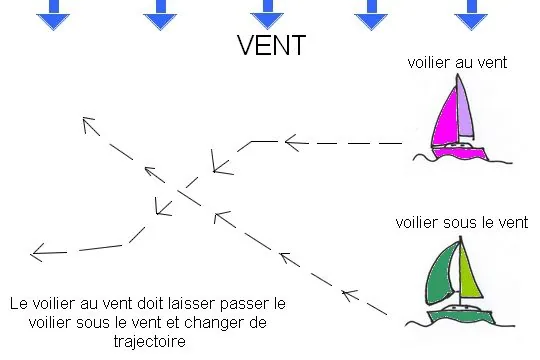
When crossing paths, the upwind kite keeps its kite high and the downwind rider lowers their kite. You should never obstruct riders who are downwind of you.
Rule #3:
The rider on port tack (left foot forward) must maneuver when facing a starboard tack rider. The starboard tack rider must maintain their course and speed. If the port tack rider fails to maneuver, the starboard tack rider must still act, because there is no absolute priority on the water. Only privileges exist, and everyone must avoid a collision.
Rule #4:
When two riders are moving in the same direction, the faster rider must give way to the slower rider ahead of them. The overtaken rider does not lose their privilege once the passing maneuver is complete.
Rule #5:
Always look around before changing direction. Any change in course or speed, or both, must be significant enough to be immediately perceived by any rider observing it.
Rule #6:
The rider surfing a wave has priority over someone jumping or going in the opposite direction. Unfortunately, this rule is too rarely respected at wave spots.
Rule #7:
Priority must be given to other ocean and beach users who are not riding. Riders must move downwind of them.
Rule #8:
To jump, a rider needs a clear safety zone of 50m downwind and 30m upwind.
Rule #9:
When two riders are on the beach at the same time, with one kitesurfer about to enter the water and the other ready to land, both must keep clear of each other.
☼ Golden Rule #1:
If you pass upwind, keep your kite HIGH.
If you pass downwind, keep your kite LOW.
☼ Golden Rule #2:
Respect and common sense
► ALL OUR
GUIDES AND TUTORIALS
► Common sense in kite, wingfoil, and windsurf:

When I cross paths with a wingfoiler or windsurfer while kiting, always let them pass upwind. This makes things easier for everyone, because for a wing or windsurf board mast to clear a kite's lines, the kiter has to bear away significantly.
If I cross a wingfoiler or windsurfer while kiting and they're struggling to get past the bar due to insufficient wind for the swell, be nice and give them some space.
When I'm surfing on a kite, wingfoil, or fun board and there are surfers paddling nearby: It's always a good move to let them catch their wave first, then take the next one.
Jumping between swimmers or surfers: Sure, the water might be flatter there, but is the risk really worth it?
When I'm doing my waterstart, I wait for the rider already in action to pass me.
Never ride in a prohibited spot-that's just basic common sense.
Do not ride in swimming areas, that's still basic etiquette.
Always respect the designated take-off zones.
► If your equipment breaks or you lose it at sea :
Call the safety services (CROSS number: 196) if you lose equipment so that rescue teams are not deployed unnecessarily. Most importantly, put your name and phone number on your kite and board. This allows rescue services to call you and avoids searching for you at sea for hours. (It's mandatory, GlissEvolution offers stickers to label your equipment).
► The most common mistakes and urban legends in Kitesurf and Wingfoil:

#I have the right of way!
At sea, there are no rights of way, only privileges. That distinction is crucial. Everyone must maneuver to avoid a collision!
"Every vessel must use all available means appropriate to the prevailing circumstances and conditions to determine if there is a risk of collision. If there is any doubt about the risk of collision, it must be assumed that such risk exists."
#Starboard tack rules the seas!
Starboard tack or not, you might still need to yield your privilege depending on the situation. This applies when you're passing a rider sailing downwind or a slower rider you are overtaking.
#When overtaking, I maneuver as if I were alone in the world!
The rule for overtaking vessels requires the overtaking craft to yield privilege until all risk of collision is completely eliminated.
#I'm a beginner, so I have the right of way!
If the beginner rider is in a designated Kite lesson area with appropriate markings, yes. But when riding with full range, certainly not. This does not prevent the advanced rider from avoiding them. Avoid or pass under their Kite, and do not complain because the beginner dropped their Kite on you.
#I'm on a windsurf board, so I have the right of way because I'm less maneuverable...
This is a complete urban legend. It's always up to the more maneuverable vessel to yield the privilege to the less maneuverable vessel, based on its current condition, not its type of craft!
However, letting a surfer paddling catch a wave while you're on a wing, kite, or board, is simply good manners!
#I have a sailboat with an engine running, so I have priority over a motorboat!
An engine running means mechanical propulsion, period.
You can actually see it in your wake; a boat sailing purely under sail doesn't create any wash.
#I perform my port maneuvers under sail, so I go first!
Port maneuvers under sail are prohibited, so there are no privileges. Some boats aren't equipped for an engine, and their users prefer not to install mechanical assistance or row, forcing them to tack. Don't bother, these are purists. And are you really in such a hurry?
► ALL OUR
GUIDES AND TUTORIALS
► Kite, Wingfoil, and Windsurf Glossary:
Vessel:
Any craft or apparatus of any kind, including non-displacement craft such as seaplanes, used or capable of being used as a means of transportation on water."
Privilege:
Advantage: A particular benefit that grants a favorable position.
Priority:
Right of Way: The privilege to proceed before another, as granted by regulation or law.
Tacks:
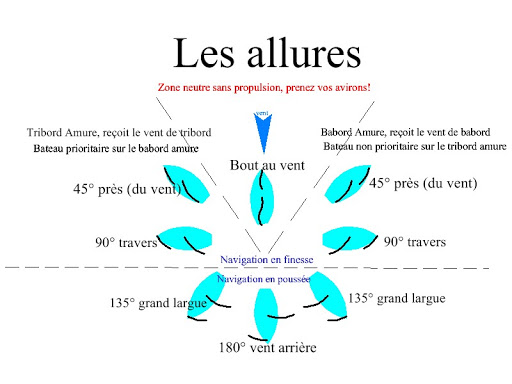
The tack refers to the side of the boat that the wind hits first. This means you have two starboard tacks and port tacks. If you're facing the direction of travel and the wind comes from the right, you're on a starboard tack. If it comes from the left, you're on a port tack. That's the theory!
When wingfoiling, kitesurfing, or windsurfing, it's simpler: if your right hand is forward, you're on a starboard tack. If your left hand is forward, you're on a port tack.
COLREGs:
The International Regulations for Preventing Collisions at Sea dictate our good conduct at sea. Even though this document is for vessels, and kitesurfing, wing foiling, and paddleboarding are considered beach craft, we must respect these common-sense rules written in black and white.
Upwind:
The term "upwind" describes an object's position relative to the wind source. It means the object is on the side from which the wind is blowing, compared to a reference point. The object is beyond a line perpendicular to the wind passing through the reference object, and it receives the wind before the reference object.
Downwind:
The term "downwind" describes an object's position relative to the wind source. It means the object is on the opposite side from which the wind is blowing, compared to a reference point. The object is beyond a line perpendicular to the wind passing through the reference object, and it receives the wind after the reference object.
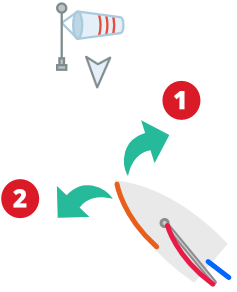
Luffing / Bearing Away in Kite, Wingfoil, and Windsurf:
You either head closer to the wind, which is called luffing (1).
Or you head away from the wind, which is called bearing away (2).
A sudden change in direction is called a yaw. This includes:
Luffing: when the boat heads up.
Bearing away: when the boat heads down.
► ALL OUR
GUIDES AND TUTORIALS
| Rule | Situation | Who has the right of way? |
|---|---|---|
| #1 | A rider entering the water from the beach. | The rider entering the water, not the one already riding. |
| #2 | Two kites crossing paths. | The upwind kite keeps its kite high, while the downwind kite lowers it. |
| #3 | Port tack crosses starboard tack. | The starboard tack rider maintains course and speed; the port tack rider maneuvers. If not, the starboard tack rider must act. |
| #4 | Two riders going in the same direction. | The slower rider is in front; the overtaking rider yields until all risk is avoided. |
| #5 | Change of course or speed. | Look around you. Any change must be clear enough to be immediately perceived. |
| #6 | A rider surfing a wave. | The rider surfing has priority over someone jumping or coming from the opposite direction. |
| #7 | Non-navigating users (swimmers, beachgoers). | They have priority; the rider moves downwind of them. |
| #8 | Jump | Maintain a clear safety zone of 50 m downwind and 30 m upwind. |
| #9 | One kiter taking off while another is landing. | Both riders should keep clear of each other. |
Frequently Asked Questions
Is there a right of way in kitesurfing?
No. At sea there are no rights of way, only privileges. The distinction is important: everyone must maneuver to avoid a collision. The COLREGs require using all available means to determine if a risk of collision exists. They also state that if there is any doubt, assume the risk exists.
Who has privilege between port and starboard tack?
The rider on port tack maneuvers. The rider on starboard tack maintains their course and speed. If the port tack rider does not maneuver, the starboard tack rider must act. There is no absolute privilege. A simple way to remember on the water: if your right hand is forward, you are on starboard tack. If your left hand is forward, you are on port tack.
What safety distance is needed for jumping in kitesurfing?
You need a clear area of 50 m downwind and 30 m upwind. Jumping between swimmers or surfers because the water is flatter there is never worth the risk.
Does a beginner have priority on the water?
Only if they are in a designated Kite lesson area with appropriate markings, similar to a channel. When riding in full range, no. This does not prevent an advanced rider from avoiding them and passing under their Kite rather than complaining afterwards.
What should you do if you lose equipment at sea?
Call the safety services at 196 (CROSS) to avoid sending out rescue teams unnecessarily. Most importantly, have your name and phone number on your kite and board. This is mandatory. It allows rescue services to call you instead of searching for you at sea for hours. GlissEvolution offers stickers to label your equipment.
Got a question about the gear mentioned here?
The GlissEvolution team rides what they sell and is ready to answer your questions directly.