Slingshot Project Drag: parawing board test and review (Hadou Brunner and Hydro Gav reviews)
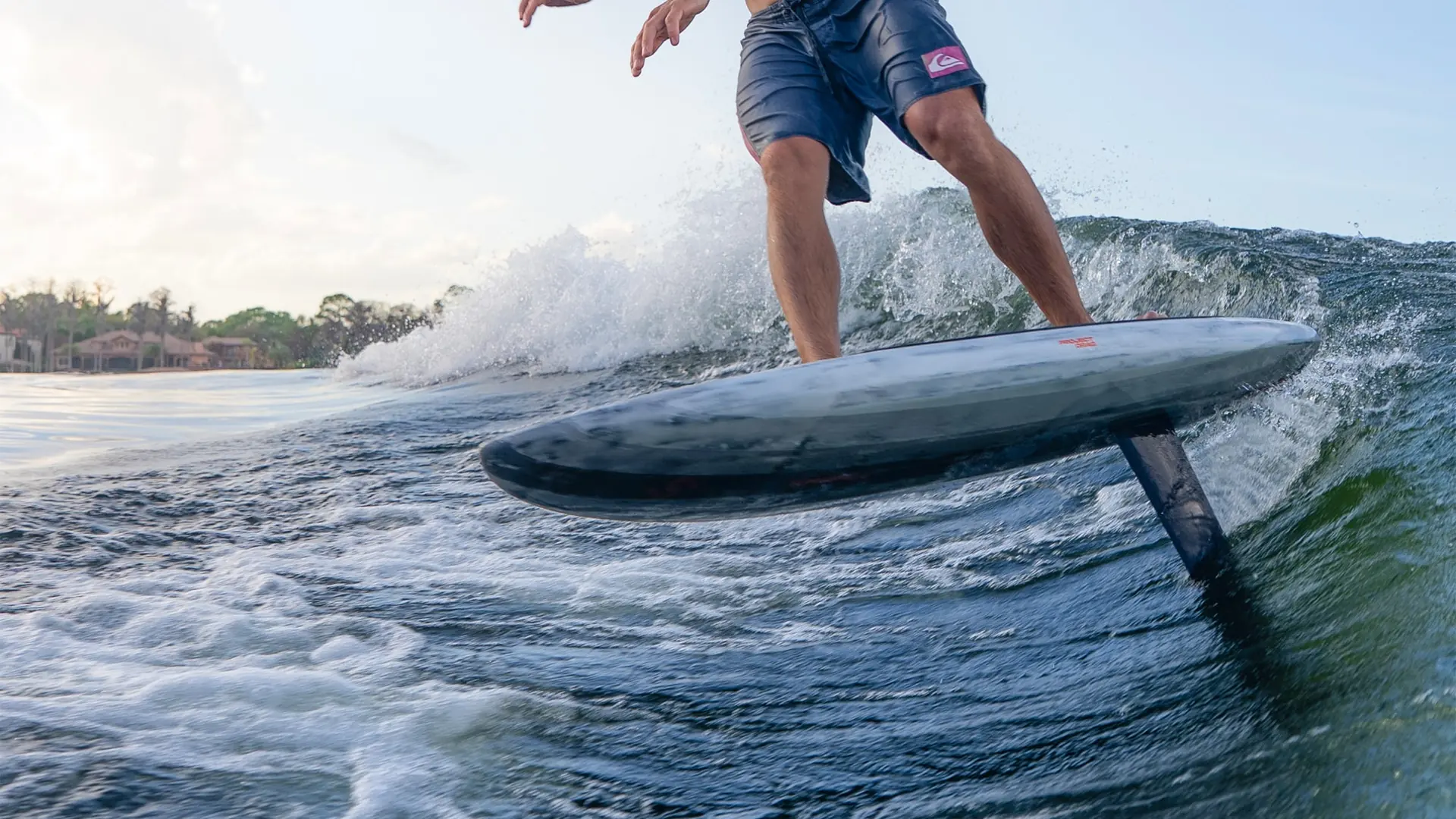
With its banana shape and rounded rails, this board stands apart from anything else on the market. Two testers put it through its paces: Hadou Brunner on the 62 L, winging and parawing, from flat water in very light wind to good bumps; and Hydro Gav on the 72 L, over several weeks with multiple foils. They both reached the same conclusion: when it touches the water, almost nothing happens. The trade-off is in the take-off, which demands active input.
Huge thanks to Hadou Brunner and Hydro Gav for their reviews of the Slingshot Project Drag, published on their YouTube channels on October 19 and June 23, 2026.
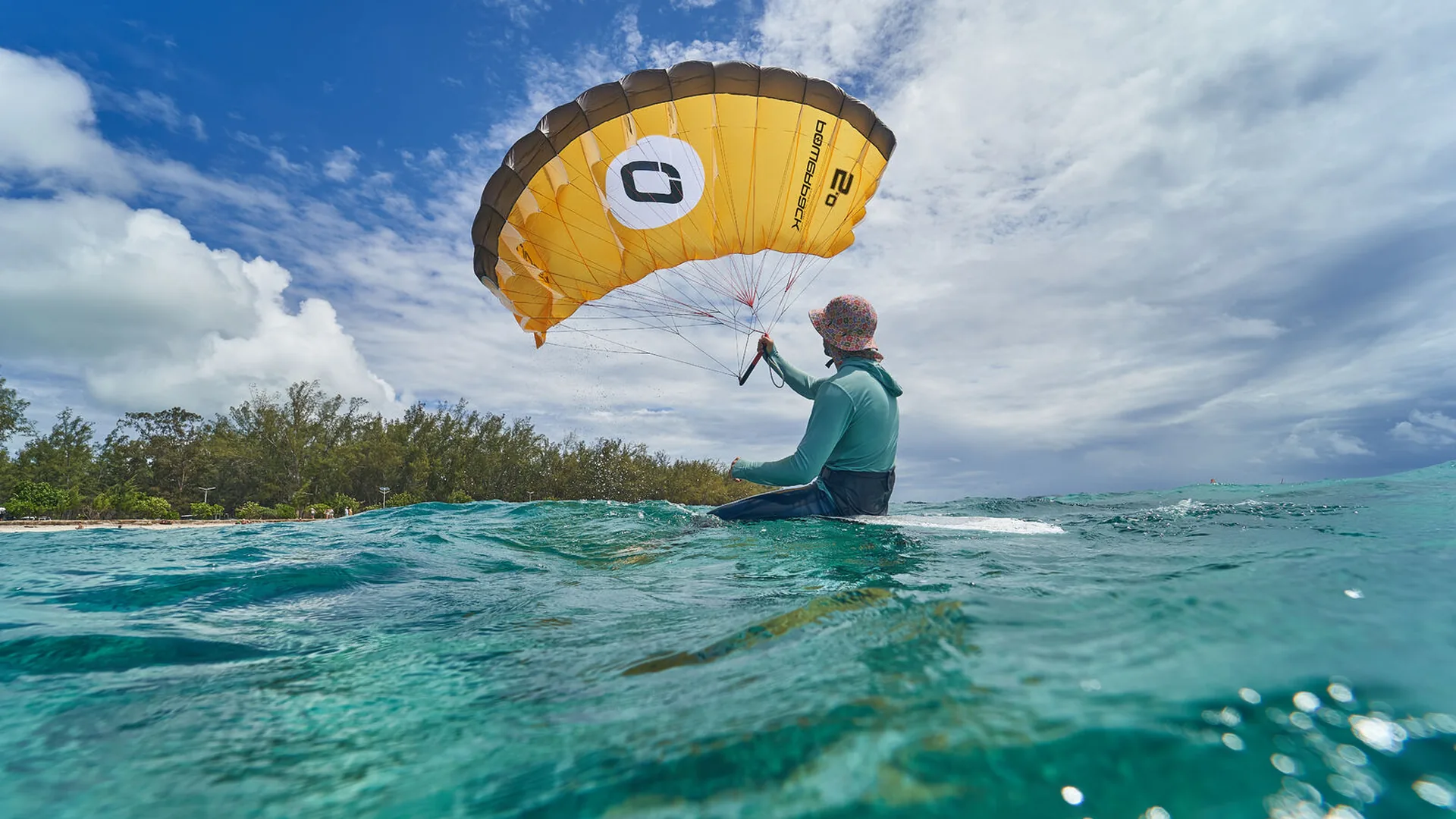
The Slingshot Project Drag is a parawing and downwind board. You can also use it for wingfoil carving and freefly. It comes in six volumes, from 50 to 114 L, with either a Tuttle fin box or track system. Prices range from 1,799 to €1,899 (tax included), and it comes with a bag.
Its name says it all: this board reduces drag when it touches the water again during surfing or committed turns, not during take-off. Ken Adgate and Kyle Touhey designed it. Prices were noted in our catalog on October 19, 2026.
In short
- Product: Slingshot Project Drag Board, tested in 62 L (Track version) and 72 L.
- Testers: Hadou Brunner, 62 kg, winging and parawing; Hydro Gav, 80 kg, winging and parawing, over several weeks.
- Construction: carbon, carbon rails, recessed deck.
- Volumes: 50, 62, 72, 84, 95, and 114 L, each available in Track or Tuttle.
- Price including tax: 1,799 to €1,899 as of October 19, 2026, bag included.
- Program: parawing and downwind, wingfoil for carving and freefly.
- Verdict: Both testers found this board to be the most forgiving for touchdowns. It's best for riders who know how to take off by pumping.
What the testers loved
- They both agreed on its superior tolerance for touchdowns compared to anything else they've tested.
- It features a very recessed deck, a pad that extends over the rails, and very little nose in front of the front foot.
- This board is incredibly stiff and light: 4.2 kg for the 62 L, and 4.4 kg for the 72 L.
- This board carves incredibly hard, with Hydro Gav finding no limits.
- Take-off requires pumping; you can't passively pull the board up.
Who tested it, and under what conditions
Hadou Brunner tests wing and parawing gear year-round on his YouTube channel. He received the Project Drag in 62 L, Track version, and rode it for both wing and parawing. He used it in very light wind on flat water, a scenario it wasn't designed for, and then in livelier conditions with bumps and waves to surf.
He intentionally kept his reference foils, mounted in the tracks. His reasoning was that with the same foil on multiple boards, only the board changes. This makes differences in stiffness or handling more apparent. He did not test the Tuttle version with the Slingshot mast.
We haven't ridden the Project Drag yet. The On-water behaviour described here comes from their two reviews; prices and sizes come from our catalog and Slingshot.
Review by Hadou Brunner, published October 19, 2026, duration 22 min.
Hydro Gav, an independent Australian tester, spent several weeks on a 72 L (5'10-inch by 19"). At 80 kg, the 72 L barely floats when stationary. This makes it a semi-sinker board. He states he has no connection with Slingshot and admits to having followed Ken Adgate's custom boards for years, from which the Project Drag is derived. This is the weight of the board.
Review by Hydro Gav, published June 23, 2026, in English, duration 12 min 51.
A counter-current shape
The Project Drag originates from the custom boards of Ken Adgate, a parawing rider known for his aggressive carving style. Hydro Gav reminds us that Adgate was developing these shapes long before they became widespread. It was developed with Kyle Touhey, a heavier rider who, according to Hydro Gav, wanted a large board that rides like a small one, before it went into production at Slingshot.
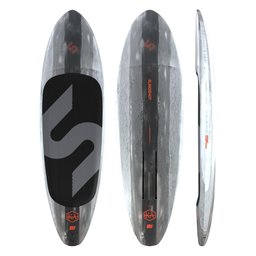
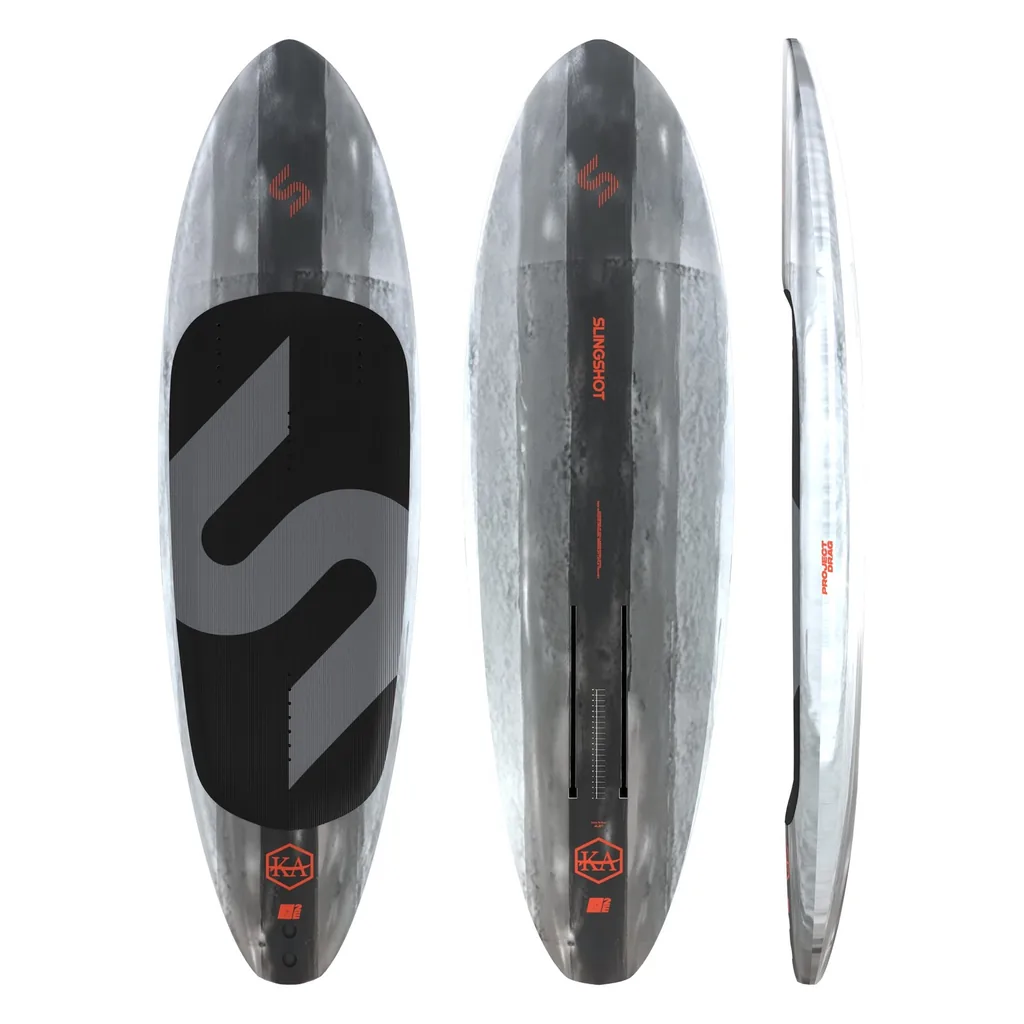
Flip the board over and look at its profile: the rocker is continuous from tail to nose. While there's a flatter area around the fin box, the hull shape remains significantly more curved than the straighter downwind boards you typically see. The rails are very rounded along their entire length. Slingshot adds pronounced front edges and an increased tail rocker.
The concept is simple: the board follows the wave's shape, touches down as late as possible, and when it does, it releases rather than braking. This contact drag is precisely what the Project Drag aims to eliminate, hence its name.
Super advanced rails
Slingshot is among the brands focused on reducing swing weight, that dead weight in front of your front foot. On Hadou's 62 L board, the rails start 35 cm from the tail and measure 30 cm. He rode with the foil positioned very far forward, his feet pressed against the front of the deck concave, with about 5 cm of pad still in front. The result in pumping? You'll completely forget you're on a 62 L board.
Construction and finishes
This board features a full carbon construction, including carbon rails. Slingshot doesn't provide cross-section views or detailed laminate information. The deck has strap inserts only at the front. This offers five positions for riders who prefer to ride strapped for freeride. This isn't designed as a jump board. It includes an automatic decompression valve and a leash plug, with no issues to report. It comes in a single colorway: gray with a touch of orange, which Hadou finds understated and easy to keep clean.
The full-length pad covers the entire deck, stopping just short of the nose, and extends up the front of the deck concave. When you flip the board over in the parking lot, both the nose and tail rest on the foam, not directly on the composite. This small detail provides crucial protection for the board every time you launch.
Track or Tuttle: two distinct versions
All six volumes are available in two versions. The Track version, which we tested, features two US-standard carbon rails and is compatible with all plate-mount foils on the market. The Tuttle version integrates the fin box directly into the board. This allows the mast to insert without a plate. This eliminates the small step found under the board between the plate and the hull shape. Hadou believes the Tuttle offers even greater drag reduction, but it does require a Slingshot mast.
Hadou received the Track version first, with the Tuttle version having just arrived. According to Slingshot, shims can be placed at the front or back of the fin box to adjust the mast position based on the rider's body size, though with a shorter adjustment range than rails. Hadou hasn't seen these shims, and we haven't had them in hand yet. The adjustable Tuttle system, including both the mast and fin box, is credited to Michael McKinley, the engineer associated with the project, as per Slingshot's presentation.
For the Tuttle version, you'll need the 80 cm One-Lock Project Drag UHM carbon mast, priced at €2,099 including tax as of October 19, 2026. If you already own a foil from another brand, the Track version is your only option to keep using it.
On the water: what our testers loved
Touchdowns: the heart of the matter
This is where the Project Drag truly stands out, and Hadou emphasizes it: while competing boards he's ridden are already good in this area, the Project Drag takes it further. With rocker at both the front and back, plus rounded rails, if the tail touches while surfing with a 75 or 80 cm mast, it simply bounces and keeps going. The same happens if the nose or a rail touches. Even a nose buried during take-off resurfaces; as soon as the board gains speed, it rises back to the surface. He describes it as the most error-tolerant board he's tested in this regard, both while surfing and riding in a straight line. Hydro Gav agrees, calling it the most forgiving board he's ridden in its category, to the point where you can push harder in turns because mistakes cost almost nothing.
You'll feel the difference even before you're flying. Kneeling on the board in choppy cross-waves, a hull shape with angular rails would typically make the rider bob. Here, the chop simply passes underneath. The board feels less connected to the water, and Hadou finds it exceptionally stable when standing up.
Hydro Gav actually expected the opposite. He thought a 19-inch wide board, at 80 kg on 72 L, would feel unstable while waiting for power. Instead, he found it incredibly settled, with its volume positioned very far forward. On the beach, the board appears much smaller than its 72 L volume suggests.
Stiffness and weight
Hadou weighed his 62 L board at 4.2 kg, which is within the 5% tolerance of the Slingshot size guide. This weight is very close to his 55 L Armstrong Midlength MK2, which is advertised at 4 kg, despite the Project Drag having a few more liters. Underfoot, he describes it as ultra-stiff. This offers a very direct feel and the sensation of being completely connected to the board. He also believes it's solid, though he can't yet judge its long-term durability.
Hydro Gav weighed his 72 L board at 4.4 kg, matching the weight listed in the Slingshot guide. He considers it the lightest production board he's tested in this category, excluding hollow boards, yet it doesn't feel fragile. It remains incredibly stiff. This ensures every pumping stroke translates directly into the foil without any energy absorption from the board.
Deck comfort
The recessed deck keeps you low, and Hadou feels the board is thicker than his 55 L Armstrong, though he acknowledges the volume difference might play a role. The pad provides a tactile reference as a front stop. Crucially, it extends over the rails without dragging in the water. For riders like him who like to shift their weight and place their toes on the board's edge, the grip remains solid. He notes he hasn't seen this detail on any other brand.
Hydro Gav emphasizes the same point. The deck's concavity is so pronounced that Slingshot prints its depth on the board, positioning your foot as close as possible to the foil. This means every pumping action and every correction is immediately effective. He also notes a slight curve in the deck, both from front to back and rail to rail. You'll use the flat part for pumping and the curved areas for holding turns. The graphics even serve as handy reference points for foot placement.
The turns
Hadou describes the Slingshot Project Drag as built for aggressive carving, and Hydro Gav reinforces that point: he couldn't find its limits, admitting his own skill level was the limiting factor. The board transitions effortlessly from rail to rail, remaining lively and intuitive, with no adaptation period. Once airborne, the volume disappears underfoot. This makes it a board heavier riders should seriously consider.
Weak points: take-off and an oversight.
On a day with barely 12 knots, winging on flat water with no chop or swell to assist, Hadou took off, flew, and had a blast. Compared to boards with a flatter rocker, the Project Drag demands more effort during take-off. The reduced rocker minimizes the flat surface around the fin box, so you need to use your legs, porpoise the board by pressing on the small tail kicker, and combine this with arm pumping. When you do this, it takes off almost as early as a board where you can remain passive.
He cites the Armstrong Midlength MK2 as an example of an easier board in this scenario. That board has a flatter rocker, is less forgiving of touchdowns, and has a less surfy deck, but it takes off more easily. That board has a flatter rocker and is less forgiving of touchdowns. It also has a less surfy deck, but it takes off more easily.
Hydro Gav reaches the same conclusion through a different path. The tail sinks a bit under load and slows down if you remain passive. As soon as you pump, the board quickly frees itself, much like a downwind SUP foil board. He estimates an intermediate rider will need one or two sessions to get used to it, while an advanced intermediate or advanced rider will find the take-off easy. His only other complaint: no leash loop is provided. Arriving at the beach, he had nothing to attach his leash to. Plan for a Dyneema loop.
Who's it for?
This board is for the advanced or expert rider who surfs bumps with a parawing or wing, does downwinders, and carves hard. That's where it truly shines. Hadou is clear: it's not for someone who rides in summer on flat water, wants to take off as early as possible while remaining passive, or has just mastered their jibes.
Slingshot, however, lists "beginner" among the board's intended uses. We follow the testers' advice, and Hydro Gav puts it his way: this is not a beginner board disguised as a performance board. If you are still progressing, a board with a flatter rocker will save you time.
Sizes and prices
| Volume | Length | Width | Thickness | Weight | Price incl. tax |
|---|---|---|---|---|---|
| 50 L | Not communicated by Slingshot. | €1,799 | |||
| 62 L (Hadou) | 5'7-inch | 19-inch | 5 3/16-inch | 4.0 kg | €1,799 |
| 72 L (Hydro Gav) | 5'10-inch | 19-inch | 5 11/16-inch | 4.4 kg | €1,799 |
| 84 L | 6'0-inch | 20 1/2-inch | 5 7/8-inch | 4.8 kg | €1,799 |
| 95 L | 6'4-inch | 21 1/2-inch | 6 3/16-inch | 5.1 kg | €1,899 |
| 114 L | 6'6-inch | 22 1/2-inch | 6 7/8-inch | 5.9 kg | €1,899 |
Dimensions and weight: Slingshot size guide, length in feet and inches, board weight alone within 5%. (Hadou) and (Hydro Gav): tested volumes. Prices are identical for Track and Tuttle, as listed in our catalog on October 19, 2026. Availability changes, so contact the shop.
Which volume to choose.
Hadou weighs 62 kg and rode the 62 L. He felt like he was on a bigger board than his usual 55 L, to the point of thinking he could have easily taken the 50 L. He still found the 62 L reassuring, precisely because the rocker requires more commitment on take-off. Your weight, your wing, and your spot are as important as his: call us before deciding.
Hydro Gav, at 80 kg on the 72 L, was at the limit of the board sinking when stationary, yet found it stable. Two riders, the same impression: the Project Drag feels more voluminous than its liters once you stand on it, and smaller than them once flying.
Specifications
| Feature | Slingshot Project Drag. |
|---|---|
| Type | Parawing, downwind, and wingfoil board. |
| Volumes | 50, 62, 72, 84, 95 and 114 L. |
| Foil connection. | Track (two carbon rails, US standard) or integrated Tuttle fin box. |
| Shape | Continuous rocker, rounded hull shape, pronounced front edges, increased tail rocker. |
| Construction | Carbon, laminate details not published. |
| Deck | Recessed, full-length pad that extends over the rails, 5 strap insert positions at the front. |
| Weighed weights | 4.2 kg for 62 L (Hadou Brunner), 4.4 kg for 72 L (Hydro Gav). |
| Delivered with | Custom bag, no leash loop. |
| Design | Ken Adgate and Kyle Touhey, Tuttle system by Michael McKinley. |
The bag, a real plus.
The board comes in a custom white bag that can stay in the sun. It has a handle on the edge, a shoulder strap, a very practical central handle for carrying larger volumes, and a small pocket. Hadou reminds us that other brands, like Armstrong, also deliver their boards with a bag, which means one less thing to buy in addition to a board of this price. Hydro Gav also considers it a real bonus that he wasn't expecting.
The testers' verdict.
At the end of his review, he ranks it among his current favorite boards. He highlights its pure joy in surfing, rare deck comfort, stiffness that creates a direct connection with the foil, and very advanced fin boxes that leave little nose in front of the front foot. The trade-off is the take-off, which requires active input, hence his advice to reserve it for advanced and expert riders. Regarding the price, he finds it expensive, like all boards of this caliber, but well-positioned compared to other brands.
Hydro Gav goes further. After several weeks of trying to find flaws, he found none other than the leash loop, ranking it among the most impressive boards he has ridden. His conclusion: a production board that rides as well as the custom boards it's based on, and gives the impression of riding even better.
Our expert advice: this is the wing foil board for riders who love surfing bumps, frequently touch down, and want an effortless ride. For light wind, flat water conditions, we'd steer you towards a board with a straighter rocker line.
Things to consider before buying.
If you primarily ride in summer on flat water, in 10 to 12 knots, the Project Drag isn't for you. Hadou makes that clear. Already have a foil you love? Go for the Track version. The Tuttle system locks you into Slingshot gear, mast included. Hadou didn't show or test the mast position adjustment with shims for the Tuttle. Also, remember to grab a leash loop; it's not included in the pack.
The full range is here: parawing boards, and wing foil boards.
Frequently Asked Questions about the Slingshot Project Drag
What is the Slingshot Project Drag for?
This is a parawing and downwind board. You can also use it for wingfoil carving and freefly. Its banana shape and rounded rails reduce drag when the board touches the water again, whether you are surfing or making an aggressive turn. Hadou Brunner and Hydro Gav both find it more forgiving on touchdowns than other boards they have tested.
Track or Tuttle: Which Project Drag version should you choose?
The Track version has two carbon rails to US standard. It accepts plate foils from all brands. The Tuttle version integrates the box into the board without a plate. It requires a Slingshot mast, the One-Lock Project Drag UHM. If you want to keep your current foil, choose the Track. Both versions are the same price.
Which Project Drag volume should you choose?
Hadou Brunner, 62 kg, rode the 62 L. He found it felt more voluminous than his usual 55 L board. He even thought the 50 L would have been enough for him. Hydro Gav, 80 kg, found the 72 L stable even though he was almost semi-sinker. The right volume depends on your weight, your wing, your level, and your spot. Call us or visit the shop.
Is the Project Drag suitable for a beginner or intermediate rider?
According to both testers, no. Hadou Brunner reserves it for advanced and expert riders. Hydro Gav says confirmed intermediates can use it. Its rocker requires an active take-off. A rider who has just learned jibes or wants to take off passively will do better on a flatter board.
Does the Project Drag take off well in light wind?
It takes off, but it requires more effort than a flatter board in very light wind on flat water. Hadou Brunner observed this at just 12 knots in wing. By porpoising the board and pumping with his arms, he takes off almost as quickly. Hydro Gav describes the same active take-off, like a downwind board. With swell, chop, or enough wind, he says the difference disappears.
What is the price of the Slingshot Project Drag?
As of October 19, 2026, it is €1,799 including tax for 50 to 84 L, and €1,899 including tax for 95 and 114 L. Both Track and Tuttle versions are the same price, and a bag is included. For the Tuttle version, the 80 cm One-Lock Project Drag UHM mast is €2,099 including tax.
What comes with the Project Drag?
The board comes with its custom bag, which has a handle on the edge, a central handle, a shoulder strap, and a small pocket. The mast and foil are sold separately. Hydro Gav notes that no leash loops are included.
Unsure about the volume or version?
Track or Tuttle, 50 or 62 L: a quick phone call often helps you decide, based on your current foil and riding style.
Make an appointment 09 62 64 74 77 Contact us See the Project Drag
Test sources: video reviews by Hadou Brunner, published October 19, 2026, and Hydro Gav, published June 23, 2026. Tuttle system: project presentation in Foil Life podcast no. 136, June 2026. Advertised features and size guide: Slingshot Project Drag Board product page, consulted October 19, 2026. Prices and sizes noted in our catalog on October 19, 2026.
 Slingshot